How Shared Web Platforms Merge Quick Reflex Tasks with Narrative Planning in Family-Oriented Group Play
Geschrieben von Jordan Hansen · 9.9.2026
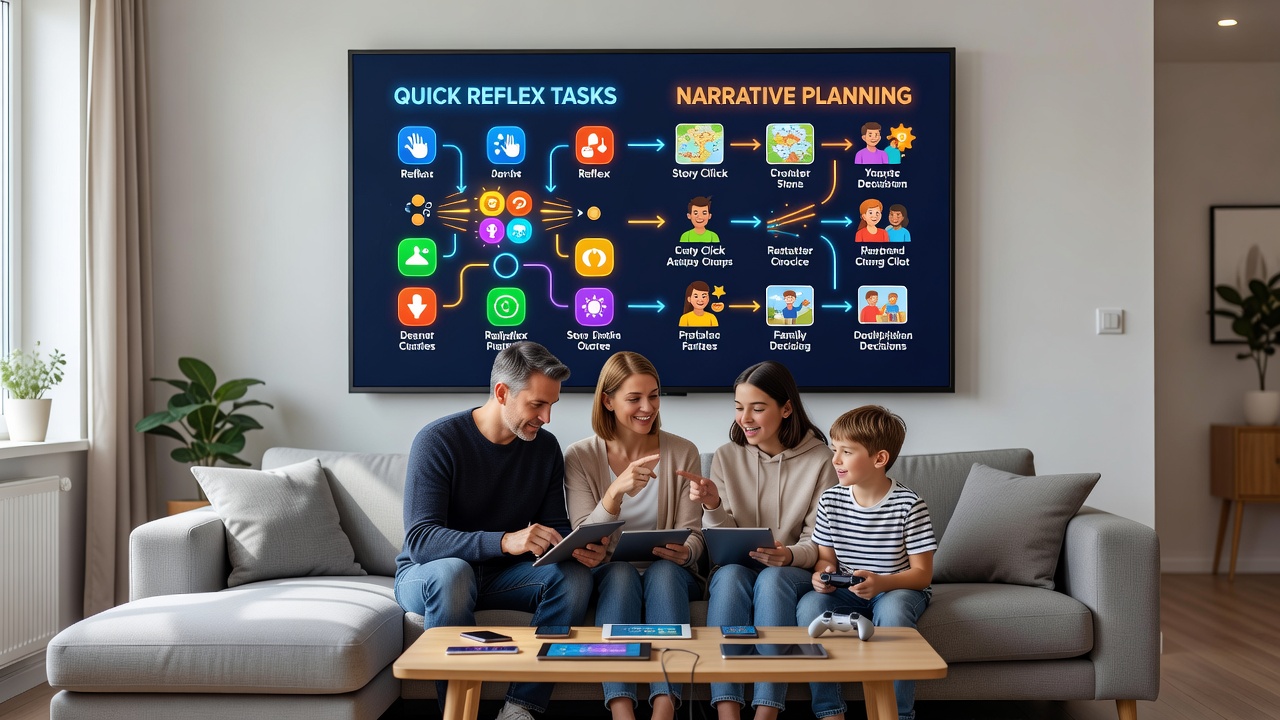
How Shared Web Platforms Merge Quick Reflex Tasks with Narrative Planning in Family-Oriented Group Play
Shared web platforms have integrated quick reflex tasks with narrative planning elements in family-oriented group play for several years, creating environments where participants alternate between immediate action responses and longer-term decision sequences. These systems typically run in standard browsers, allowing mixed-age groups to join sessions without specialized software installations. Data from industry reports indicate that such hybrids appear across educational, entertainment, and casual gaming categories, with participation rates rising steadily through 2025.
Core Mechanics in Browser Environments
Quick reflex components often involve timed inputs such as precise clicks, directional movements, or sequence matching that demand rapid physical responses, while narrative planning requires players to allocate resources, select dialogue paths, or map out multi-step objectives over extended periods. Platforms combine these layers by linking immediate successes directly to story progression, so a fast reaction in one phase unlocks options for group discussion and strategy formulation in the next. Researchers at various institutions have documented how this structure maintains engagement across age ranges because younger participants handle reflex segments and older ones contribute to planning discussions within the same session.
Platform Design Patterns Observed in 2025-2026
Designers structure these experiences around shared interfaces that display both real-time action meters and persistent story maps visible to all connected users. When one participant completes a reflex challenge, the system updates a collective narrative tree that everyone reviews before advancing. In September 2026 several major browser services introduced synchronized timers that pause automatically during group planning phases, ensuring reflex elements do not interrupt collective decision-making. Figures from the Entertainment Software Association reveal that family multiplayer titles incorporating these dual systems accounted for measurable increases in session duration compared with single-mechanic games.
Coordination occurs through built-in chat overlays and visual indicators that highlight which tasks require speed and which benefit from deliberation. Observers note that platforms often embed tutorial sequences teaching both skill types simultaneously, so new users learn timing accuracy while also reviewing branching story consequences. Studies published in academic journals show that groups using these integrated tools demonstrate improved task-switching performance after repeated sessions.

Examples of Integration Across Regions
European platforms frequently embed cultural storytelling frameworks where reflex sequences represent environmental events and planning phases involve community resource allocation. North American services tend to feature episodic content updated monthly, with each episode containing distinct reflex segments that feed into overarching plot choices. Australian industry data compiled by the Interactive Games and Entertainment Association indicate similar patterns in local browser offerings, with emphasis on cooperative scoring systems that reward both quick individual actions and accurate group forecasts. These regional variations share the common trait of allowing simultaneous participation by children and adults through adjustable difficulty sliders that affect only the reflex layer while leaving narrative options open to all.
One documented case involved a platform that introduced seasonal events in late 2025 where reflex challenges generated unique story artifacts; families then voted on how those artifacts altered future narrative branches. Participation logs showed consistent multi-generational involvement, with average group sizes ranging from three to six users per session.
Data on User Interaction Patterns
Analytics collected across multiple services demonstrate that sessions combining both mechanics sustain attention longer than those focused solely on reflexes or planning. According to aggregated reports, groups complete reflex segments in under thirty seconds on average before shifting to discussion periods lasting two to five minutes. This rhythm appears across age combinations, though exact timings vary by content theme. University-led observations further indicate that shared progress tracking features reduce instances of individual dominance, allowing quieter participants to contribute during planning intervals.
Security and privacy standards applied to these platforms follow established regional guidelines, with data handling practices documented in service documentation. Access controls typically include age-appropriate filters and parental oversight modules that monitor activity without restricting narrative choices.
Conclusion
Shared web platforms continue to refine the connection between quick reflex tasks and narrative planning through iterative updates and cross-regional design influences. Available evidence shows these systems support family group participation by balancing immediate actions with collective strategy elements in accessible browser formats. Ongoing data collection through 2026 will likely reveal additional patterns as more services adopt synchronized timing and progress-sharing tools.